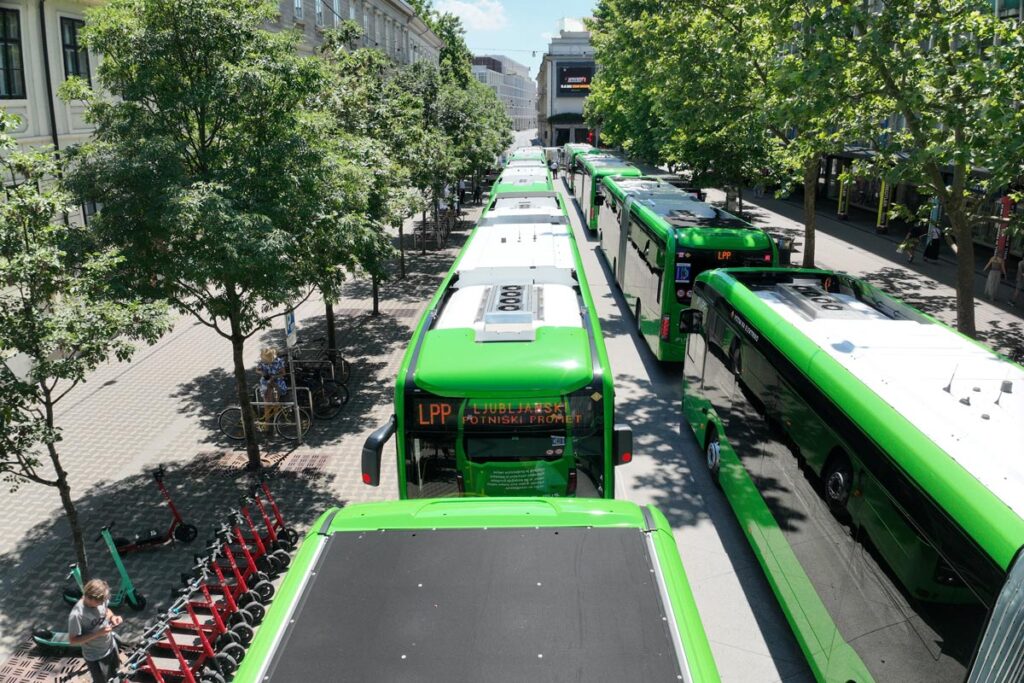
The Slovenian capital of Ljubljana is pursuing a technology-neutral approach in transforming its public transport system by combining battery-electric and hydrogen technologies. Within one year, the municipal transport operator Ljubljanski Potniški Promet (LPP) has put a total of 35 locally CO?-free Mercedes-Benz buses into operation. The fleet comprises 25 battery-electric Mercedes-Benz eCitaro buses and ten Mercedes-Benz eCitaro G fuel cell buses, forming the foundation for flexible and reliable scheduled service operations.
Battery and Hydrogen as a Strong Team
Rather than relying on a single technology, LPP combines the respective strengths of both drive systems. The battery-electric Mercedes-Benz eCitaro buses are particularly well suited for city routes with predictable duty cycles and regular charging opportunities. The Mercedes-Benz eCitaro G fuel cell buses complement the fleet on routes with higher range requirements and an additional need for operational flexibility.
With this approach, the company can optimally meet different requirements across its route network while ensuring high vehicle availability. The investment also represents the largest fleet modernization project in the history of the public transport operator.
“Over the past year, we have built a locally CO?-free fleet based on both battery-electric and hydrogen technology. Together, they create the foundation for reliable and future-ready public transport,” says Dr. Rok Vihar, CEO of LPP.
A Holistic Mobility Concept for the Future
The transition to locally CO?-free mobility in Ljubljana goes far beyond the procurement of new vehicles. Alongside the fleet renewal, LPP has established the required charging and hydrogen infrastructure and further developed its operational processes for the deployment of the new drive technologies. The city is thus pursuing a holistic approach that connects vehicles, infrastructure, and operational processes while creating long-term flexibility for future requirements. The project also supports Ljubljana’s participation in the European initiative “100 Climate-Neutral and Smart Cities”, which aims to support cities on their path to climate neutrality.
“The transition to locally CO?-free mobility today is far more than simply a vehicle issue. What matters is the interaction between vehicle technology, infrastructure, and operational expertise. LPP impressively demonstrates how these elements can work together successfully to create efficient and future-ready public transport,” says Rasto Oderlap, CEO of Autocommerce, the general distributor of Mercedes-Benz buses in Slovenia.
Greater Comfort for Passengers and Drivers
The new Mercedes-Benz buses not only contribute to reducing CO? emissions and noise pollution but also improve the driving experience and passenger comfort. The quiet drivetrain, low vibration levels, and modern safety and assistance systems ensure a pleasant travel experience in everyday urban traffic. In addition, the vehicles offer a high level of accessibility and comfort.
The project demonstrates how battery-electric and hydrogen technologies can complement each other effectively to make public transport climate-neutral step by step.