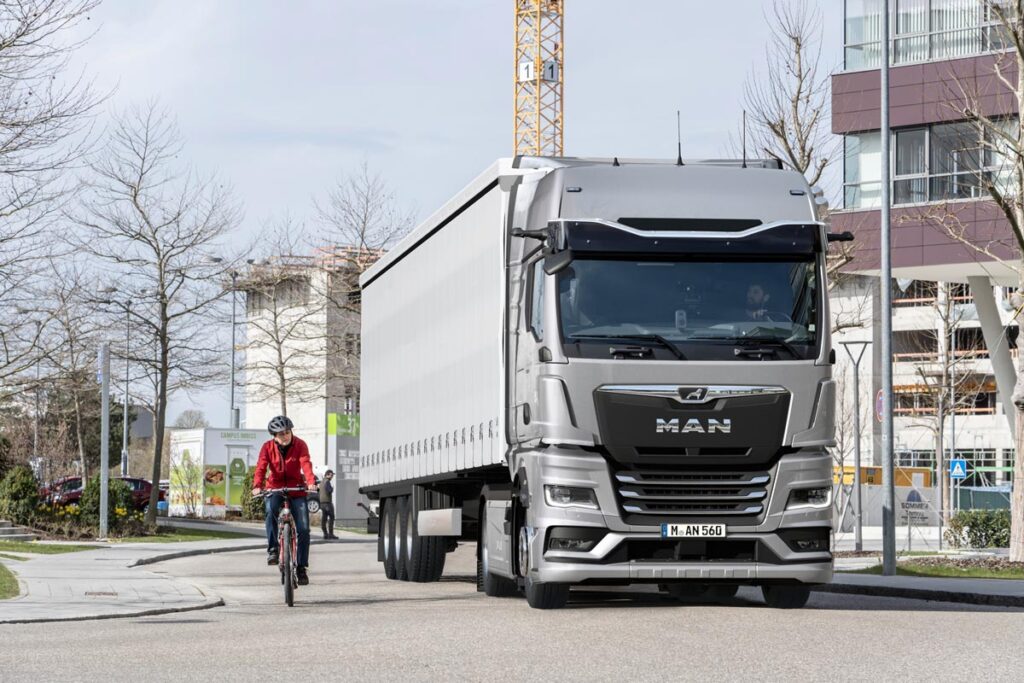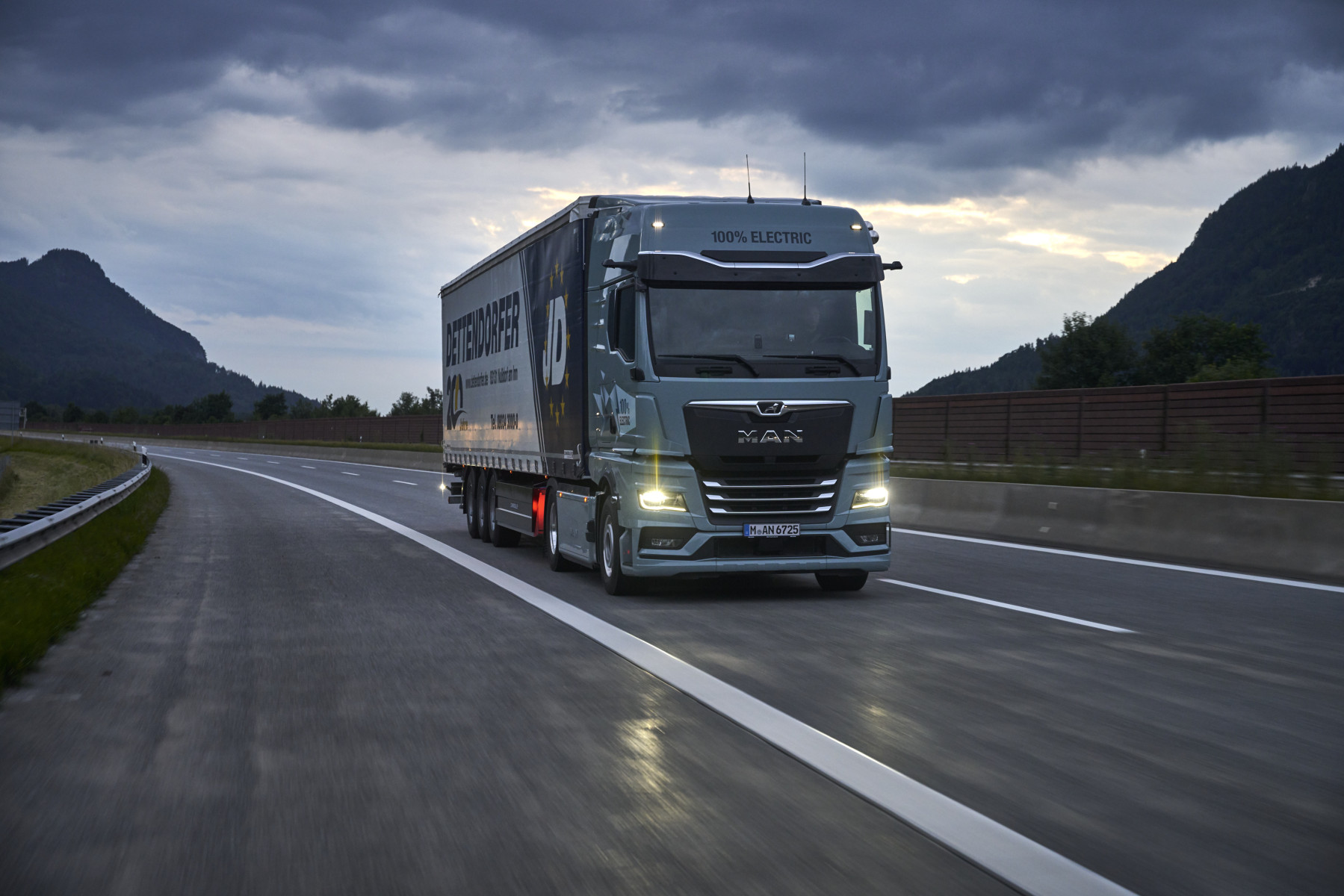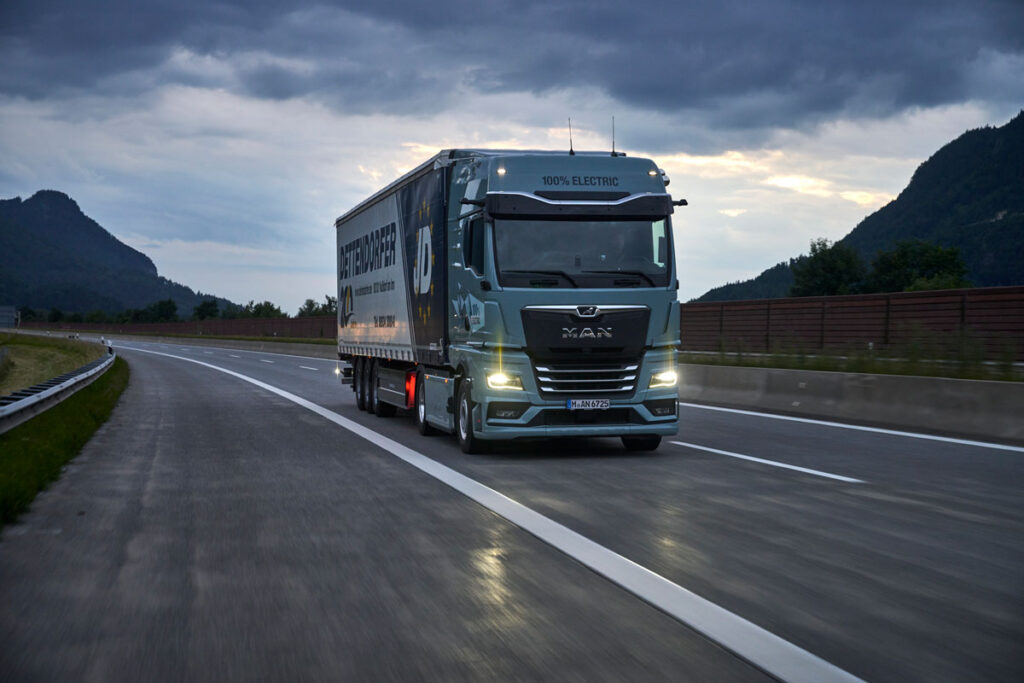
With the newly founded “Initiative Green Brenner”, MAN Truck & Bus and Dettendorfer Energy GmbH, together with partners from industry, energy and infrastructure, are giving fresh impetus to the use of battery-electric trucks on the Brenner route.
Climate protection is clearly at the forefront. Each e-truck saves an average of around 95 tonnes of CO? per year compared to a diesel-powered truck – based on an annual mileage of 110,000 kilometres. Even with just 300 vehicles per day, the potential savings amount to up to 28,000 tonnes of CO? per year – on a par with the emissions of a small town.
However, it is not only the climate that benefits from the new drive technology; local residents do too. Noise pollution is significantly reduced: during accelerated departure, electric trucks generate 12.6 dB less noise than their diesel counterparts and are subjectively perceived as considerably quieter – roughly half as loud. Particularly in the narrow valleys of the Brenner, this is a decisive factor for public acceptance. In addition, electric trucks operate in an almost entirely locally emission-free manner: the particulate emissions that occur with combustion engines are eliminated entirely, and the use of recuperation on downhill stretches reduces brake wear.
“The Brenner is a stress test for European freight transport – and at the same time concrete evidence that electric mobility in heavy goods transport can already make a significant contribution to alleviating the traffic problem today. Until the completion of the Brenner Base Tunnel, e-trucks can make an important contribution to easing the burden,” says Dr Frederik Zohm, Executive Board Member for Research and Development at MAN Truck & Bus.
Against this backdrop, MAN Truck & Bus and Dettendorfer Energy GmbH, together with their partners, are launching the “Initiative Green Brenner”. The aim is to develop the Brenner corridor as a model region for emission-free logistics – explicitly not as competition, but as a complement to rail. Until the completion of the tunnel, it will serve as a fast transport alternative; thereafter, for instance, for traffic flows that cannot be avoided or shifted to other modes.
The initiative sees itself as part of an integrated transport system. It specifically addresses road freight transport, which will continue to be necessary in the future as transport volumes keep rising. Scaling up the initiative depends in particular on the expansion of charging infrastructure and grid capacities along the European transit corridor. The initiative builds on successful initial practical experience.
“For logistics companies, practical viability is ultimately what counts. This is precisely where the initiative comes in: we are demonstrating that emission-free transport in the Alpine region is not only ecologically sound, but also economically attractive – and that is the case today, not in ten years’ time,” explains Georg Dettendorfer, Managing Director of Dettendorfer Spedition Ferntrans GmbH & Co KG, a medium-sized Upper Bavarian logistics service provider with around 240 tractor units, as well as of Dettendorfer Energy GmbH, a joint venture between the regional energy supplier Energie Südbayern and Dettendorfer Spedition.
Alongside the climate and local residents, it is also the haulage companies themselves that stand to benefit from the deployment of e-trucks on the Brenner: at an annual mileage of around 110,000 kilometres, considerable cost savings can be achieved. Energy costs for e-trucks are around 40 per cent lower than those of diesel trucks, given current diesel prices. An additional efficiency advantage arises from recuperation in alpine terrain: on the Brenner route, the e-truck can recover a substantial portion of the energy used – up to around 40 per cent – through energy recuperation on downhill stretches, thereby significantly reducing overall energy consumption. Toll costs offer a further cost advantage of around 80 per cent. Overall, the total cost of ownership (TCO) over three years for an e-truck is around 20 per cent lower than that of a comparable diesel truck. Furthermore, the use of battery-electric trucks strengthens local value creation, as energy is increasingly generated and used regionally.