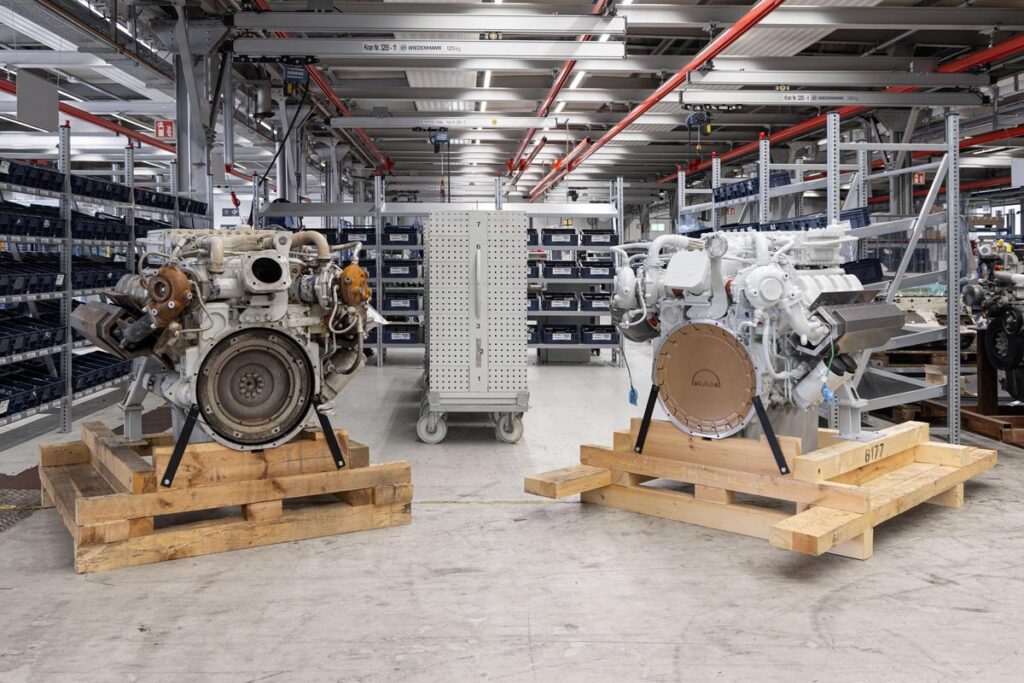
MAN is not only driving the reduction of emissions in new vehicles and new engines, but is also focusing on the entire life cycle of the products. A very important contribution to this is “remanufacturing instead of replacement”, i.e. the remanufacturing of MAN engines at the Nuremberg plant. A current Life Cycle Assessment (LCA) has now scientifically confirmed the environmental benefits of MAN Original Remanufacturing for the first time, using the MAN D2842 LE622 railway engine as an example.
The study, conducted by the University of Bayreuth, Germany, and validated by an independent expert on behalf of DEKRA Assurance Services GmbH, compares the environmental impact of a newly manufactured MAN D2842 LE622 rail engine with those of a MAN Genuine Remanufactured Engine of the same type. The result: 8,320 kilograms of CO? equivalents were determined for the production and delivery of a newly manufactured engine. CO? equivalents summarize the climate impact of various greenhouse gases in a common parameter. The MAN Genuine Remanufactured Engine causes 2,355 kilograms of CO? equivalents within the same scope of investigation. This corresponds to a reduction of 5,965 kilograms of CO? equivalents or 72 percent.
In addition to greenhouse gas emissions, the study looks at other relevant influencing factors. This reduces the use of new materials by 80 percent compared to new production. The transport capacity of the components is reduced by 87 percent. The results make it clear that the reuse of suitable components in particular can make a significant contribution to reducing material and logistics costs.
Combustion engines will continue to be needed in certain applications in the future. This is particularly true where high performance is required in a tight installation space, machines and vehicles remain in use for a long time and there are currently no suitable alternative drives. Examples of this are railway applications, especially dual-mode operation, commercial shipping and power generation. In such applications, extending product life cycles can help reduce emissions generated during the manufacture of new products.
The investigation is not limited to the comparison of a new engine with an engine that has been remanufactured once. In addition, scenarios over several life cycles were considered. If a new engine is remanufactured and reused once after its first phase of use, greenhouse gas emissions are reduced by 33 percent compared to a scenario with two new engines. In the case of further remanufacturing, the reduction increases to 45 percent compared to a scenario with three new engines. At the same time, the use of materials and transport costs continue to decrease.
“The results show the enormous potential of extending product life cycles,” says Josef Lukaschtik, Head of Remanufacturing at MAN Truck & Bus. “For applications in which combustion engines are still needed, MAN Genuine Remanufacturing can be a way to use existing resources for longer and reduce production-related environmental impacts.”
The study also provides scientifically sound evidence of the importance of remanufacturing within MAN’s service and existing business. In addition to MAN Genuine Remanufactured Engines, the portfolio also includes remanufactured components and parts from the “MAN Genuine Parts ecoline” product line. “Remanufactured components help to keep resources in the cycle for longer and offer customers cost-effective solutions with high availability,” says Vanessa Reinarz, Head of Product Management Genuine Parts at MAN Truck & Bus. In this way, MAN supports customers throughout the entire life cycle of their products – from the supply of spare parts to the professional reconditioning of complete drive systems.
The life cycle analysis was carried out in accordance with DIN EN ISO 14040 and DIN EN ISO 14044. The relevant stages of the life path within the defined system boundaries were considered. The results presented relate exclusively to the MAN D2842 LE622 examined and the framework conditions described in the study.