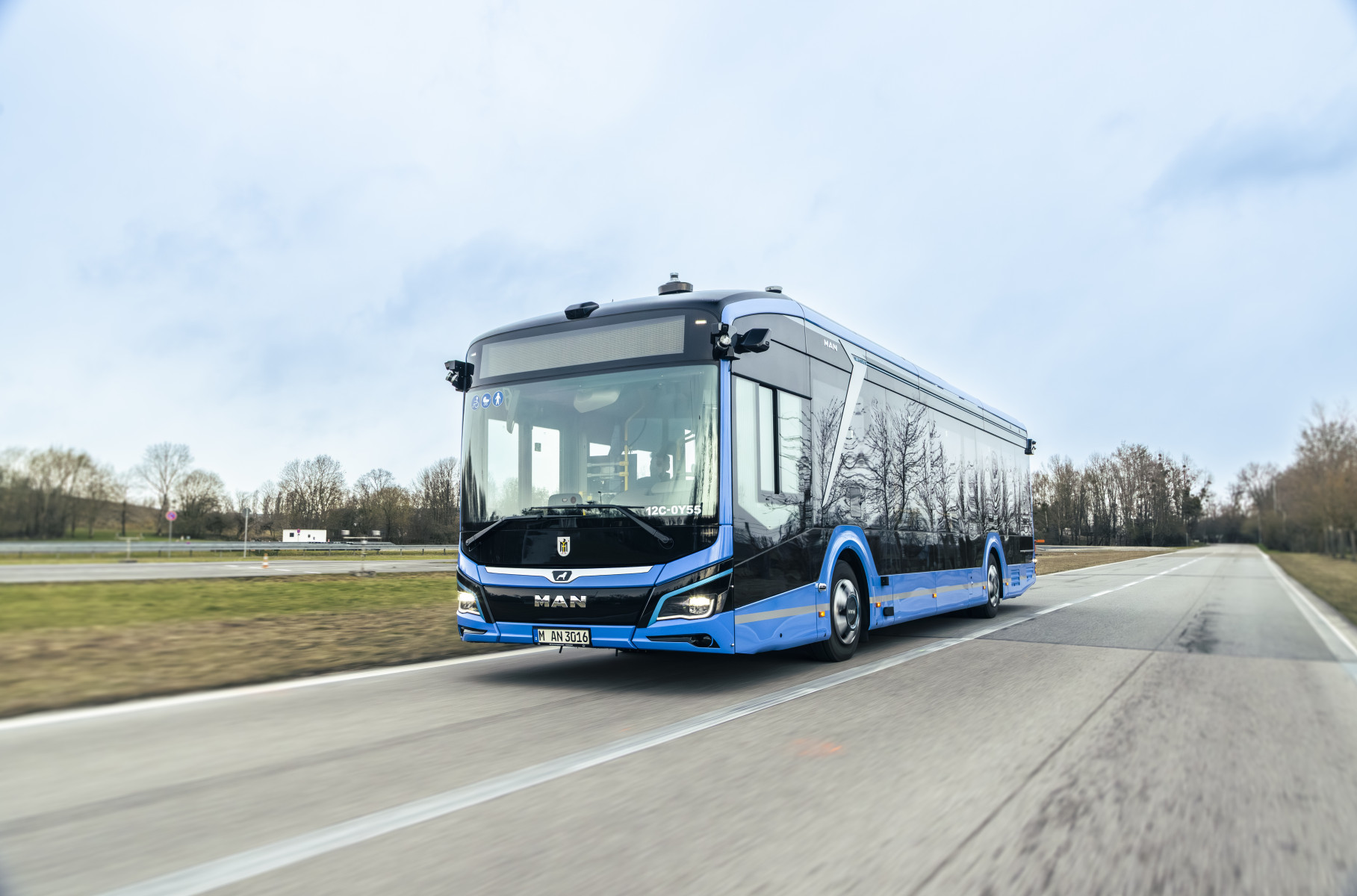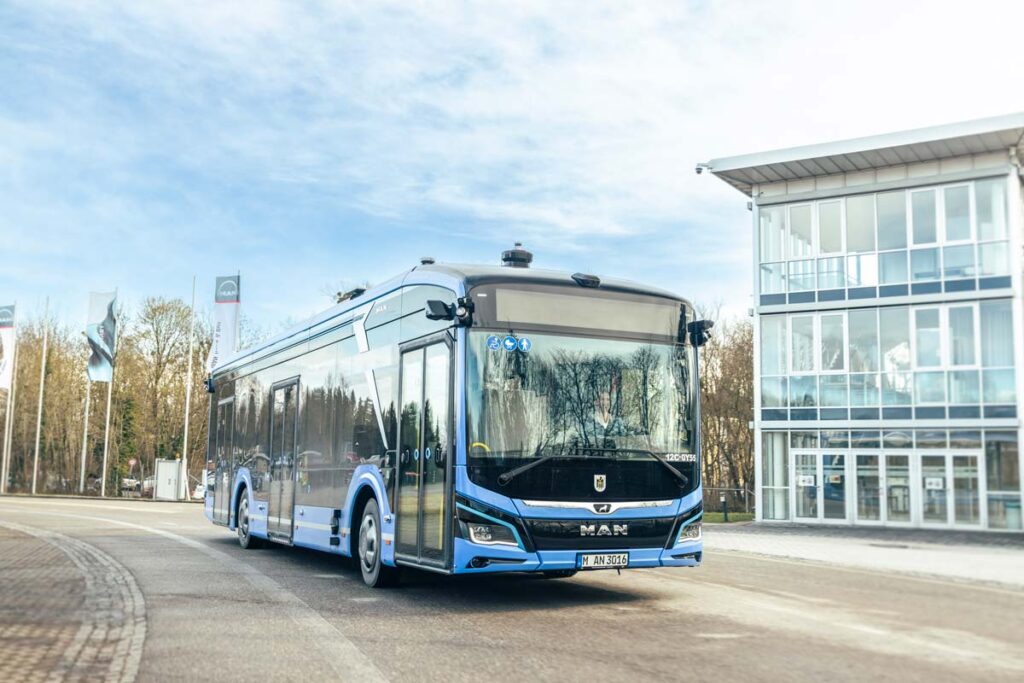
MAN Truck & Bus has reached a major milestone in the field of automated driving. Together with its technology partner ADASTEC, the company has successfully automated a fully electric city bus. “This marks another important step toward automated urban mobility,” says Barbaros Oktay, Head of Bus at MAN Truck & Bus. As part of the MINGA research project, the Munich Transport Company (MVG) is set to test the vehicle in Munich’s city traffic starting this autumn.
Over the past few months, MAN has equipped a Lion’s City 12 E with an Automated Driving System (ADS) in close collaboration with its new partner ADASTEC and integrated it into the vehicle’s electronic architecture. As a result, the vehicle, which is equipped with five LiDAR sensors, six RADARs, eight cameras, and GNSS (Global Navigation Satellite System), is technically capable of automated driving. Initial test drives are currently taking place on the MAN premises, during which specific driving maneuvers – such as approaching bus stops – are being tested. The goal of this phase is to fine-tune the system, collect important operational data, and further optimize the automated driving functions.
Germany’s Federal Minister of Transport Patrick Schnieder: “Autonomous driving is a key to the mobility of the future. Above all, it stands for greater efficiency and greater inclusion for citizens in road traffic. Projects such as MAN’s fully electric, automated city bus in Munich are therefore groundbreaking for public transportation in Germany. We expressly support such initiatives. Pioneering work is being done here that will have an impact far beyond the region and the city of Munich.”
Autonomous pilot operation planned for Munich’s public transport
Following testing on MAN’s premises, the automated electric bus is set to operate on Munich’s public roads – initially without passengers. These runs will serve as a final test phase under real-world conditions. In autumn, MVG plans to launch the official pilot operation with a closed user group. “The vehicle will, among other things, steer, accelerate, brake, and signal independently. A safety driver will be on board to monitor the systems,” explains Dr. Michael Roth, Head of Bus Strategy and Product Strategy Bus at MAN. It is also planned to systematically evaluate feedback from test users. When and under what conditions passengers will be able to ride along will be announced in due course.
By deploying automated buses, MAN aims to make public transportation more efficient, flexible, and sustainable in the future. Especially in light of growing cities and a growing shortage of drivers in the commercial vehicle industry, automated systems offer great potential for ensuring and improving mobility services. “Furthermore, autonomous driving can help reduce traffic accidents on the roads and thus increase safety,” said Roth. The findings from the MINGA project are directly incorporated into the further development of future vehicle generations. MAN has been working on driverless buses for years and plans to launch a fully automated vehicle at SAE Level 4 in the next decade – for urban mobility that is emission-free, connected, and automated.
With ADASTEC, MAN is partnering with a specialized provider of automated driving systems for the MINGA research project. The company develops SAE Level 4 (fully automated) automated driving software platform for buses and commercial vehicles.
MINGA: A key project for the mobility of the future
The MINGA research project (Munich’s Automated Local Transport with Ridepooling, Solobus, and Bus Platoons) has been underway since 2023 with a total of 16 partners from public authorities, research institutions, and industry. The Mobility Department of the City of Munich serves as the consortium leader and is responsible for the overall project. The goal is to integrate automated and connected mobility solutions into the existing transportation system and to address key questions regarding technology, regulation, cost-effectiveness, accessibility, and operations. The project is being funded with approximately 13 million euros through mid-2027 by the Federal Ministry of Transport (BMV) under the funding guideline “Autonomous and Connected Driving in Public Transportation.”
“MINGA is an enormously important project for us; after all, it is a crucial step toward a ‘proof of concept’ in regular service,” says Oktay, adding: “Once the concept phase is complete, field trials with customers are set to begin. There is enormous interest among public transport companies in autonomous buses.”