A technological breakthrough has been achieved in the NEFTON 3000 funded project: MAN Truck & Bus and the other project partners have successfully realized a stable charging current of 3,000 amperes in the interaction between vehicle and test bench infrastructure. This result marks a major advance for megawatt charging and expands the future operating possibilities of battery-electric commercial vehicles.
The series of tests carried out on test benches at the Technical University of Munich and at the Fraunhofer ISE institute in Freiburg has delivered robust data on the thermal behavior, switching components, cooling systems, and safety architecture of a charging path that could enable charging capacities of up to three megawatts (MW) in the future.
The charging performance achieved in the NEFTON project addresses a key objective of the industry: charging times must be compatible with operational processes. This brings closer a scenario in which an eTruck can recharge enough energy for a range of 400 km within 10 to 15 minutes. This progress could become particularly relevant when charging is not possible during legally required driving breaks. Transport tasks that, due to operational planning, begin without overnight charging also benefit from very high charging capacities, as the truck can return to operation quickly. In addition, operations involving two-driver teams create situations in which downtime must be kept as short as possible. In the longer term, there is also the potential to reduce battery sizes if extremely fast intermediate charging can be carried out several times per day.
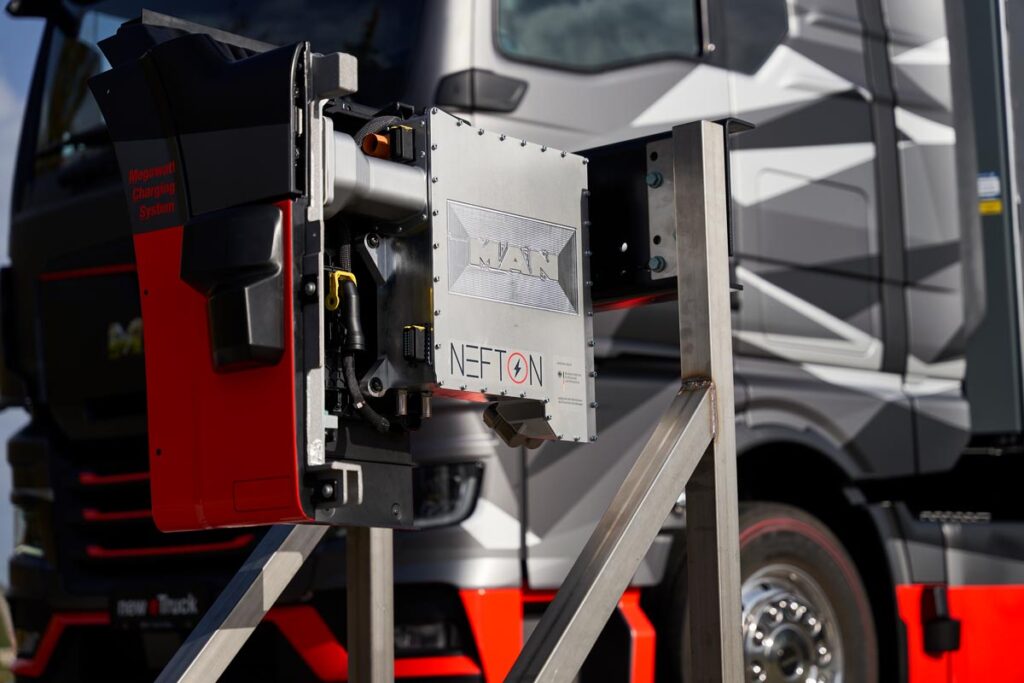
To achieve charging capacities in the megawatt range, key components were newly designed in the NEFTON 3000 project. The current path was optimized to minimize electrical resistance, as high currents generate significant heat losses. The liquid cooling of cables, connectors, and distribution units was designed to ensure that all components operate within permissible temperature ranges and can meet the high thermal and electrical requirements. Contactors and shutdown devices were designed for high switching capacities while complying with safety requirements. In addition, great emphasis was placed on vehicle-suitable integration that equally considers installation, weight, and safety.
However, for charging capacities well above one megawatt to become a reality in the future, a new generation of battery systems would first need to be developed that is specifically designed for high charging capacities. Cell chemistry, module design, and electrical interconnection would need to be optimized to efficiently absorb and process high currents. Adjustments would also be required on the infrastructure side.
The NEFTON project consortium consists of MAN Truck & Bus, AVL, the Technical University of Munich, Fraunhofer ISE, Prettl Electronics Automotive, the Research Center for Energy Economics, and Deggendorf Institute of Technology. The project was funded by the German Federal Ministry for Economic Affairs and Climate Action and supported by the DLR project management agency. In July 2024, an MAN eTGX with a charging capacity of one megawatt was already presented as an important milestone in the NEFTON project; now the charging capacity on the test bench has been significantly increased once again.
After completion of the project, the TRATON Group will continue the work. The insights gained will flow into the further development of near-production high-current charging paths as well as into studies on bidirectional functions and MCS charging with up to 3,000 amperes.